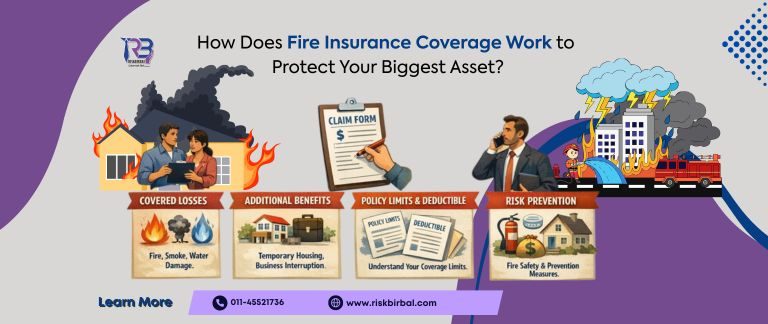
Imagine a sudden fire arise in your office, factory, or showroom, it damaged your inventory and reduced to ashes. Your machinery is ruined, walking through the damage that made. It can lead you to massive financial losses, beyond the physical damage, your business operations crush to a halt. For almost business and property owners, their building, plant, or warehouse is not just a space—it is their most significant capital asset, the very foundation of their livelihood and dreams. This is where understanding and securing robust Fire Insurance Coverage becomes not just prudent but important for survival. In this guide, we will demystify exactly how a fire insurance policy works, what it protects, and how it acts as the first line of financial defence for your biggest asset.
What Is Fire Insurance?
At its core, a fire insurance policy is a contract between you (the policyholder) and an insurance company. In exchange for a regular premium, the insurer agrees to provide financial compensation for damages or losses caused to your insured property by fire and other specified perils. It is a targeted form of property insurance designed to help you recover and rebuild without facing catastrophic financial ruin.
Who requires it? Importantly, anyone with a financial stake in a physical property. These covers:
- Business Owners: Protecting offices, retail shops, factories, and warehouses.
- Manufacturers: Covering plants, machinery, and raw material stock.
- Property Owners & Landlords: Safeguarding rental buildings and structures.
- Homeowners: For high-value residences or properties with unique risks.
How Fire Insurance Coverage Works: A Step-by-Step Guide
Understanding the mechanics of a fire insurance policy is vital to using it effectively. Here’s a simplified breakdown of the journey from purchase to claim.
Step 1: Policy Inception & Risk Assessment
The process begins with you approaching an insurer or broker such as RiskBirbal. A fire insurance for commercial property requires a detailed assessment. An advisor will evaluate your property’s construction, occupancy, fire safety measures, and surrounding hazards to determine the risk level and appropriate fire insurance coverage.
Step 2: Determining the ‘Sum Insured’
This is the maximum amount the insurer will pay in case of a total loss. Correct valuation is critical—under-insurance can lead to reduced claims, and over-insurance means you pay extra premium. Methods such as Reinstatement Value (cost of new replacement) or Market Value are used.
Step 3: The Coverage Period
The fire insurance policy is active for a specific period, usually one year. Coverage is provided for losses occurring through in this timeframe, provided premiums are paid.
Step 4: The Trigger – A Covered Peril Occurs
Your coverage comes into play only when a loss is caused by a ‘covered peril.’ For a standard fire and special perils policy, this primarily covers fire (accidental and malicious), but also extends to allied perils such as lightning, explosions, aircraft damage, riots, and more.
Step 5: Claim Intimation & Process
Upon a fire incident, you must immediately inform the insurer and the fire brigade. The next step in the fire insurance claim process involves submitting a written claim with necessary documents such as the fire brigade report, police report (if required), and proof of loss.
Step 6: Survey, Assessment, and Settlement
The insurer appoints a surveyor to investigate the cause, assess the damage, and verify the loss amount. Once validated, the claim is settled. The settlement is based on the principle of indemnity, aiming to restore you to the financial position you were in before the loss, subject to the sum insured and policy terms.
What Does a Fire Insurance Policy Cover?
A comprehensive fire insurance policy is designed to protect the physical and financial pillars of your enterprise. Here’s a clear look at its scope:
1. Covered Perils (The ‘What’ of Damage):
A typical standard fire and special perils policycovers:
- Fire: Accidental burning that causes damage.
- Lightning: Even if it does not start a fire.
- Explosion/Implosion: Including boiler explosions.
- Aircraft Damage: Damage caused by aircraft or falling objects from them.
- Riot, Strike, Malicious Damage: Losses from public unrest.
- Storm, Cyclone, Flood & Inundation: Natural calamities (often covered, but check specifics).
- Impact Damage: By vehicles or animals not belonging to you.
- Subsidence, Landslide, Rockslide: Sudden earth movements.
2. Insured Assets (The ‘What’ is Damaged):
- Building/Structure: The physical construction of your office, factory, or warehouse.
- Plant & Machinery: Important equipment for your operations.
- Stock: Raw materials, work-in-progress, and finished goods.
- Furniture, Fixtures, and Other Contents: Everything inside the insured premises.
This makes fire insurance for factory and warehouse a critical component of operational risk management, as these sites house high-value, easily damaged assets.
What Is NOT Covered? Understanding Exclusions Simply
A clear grasp of fire insurance exclusions prevents unpleasant surprises in time the of claim. Common exclusions add:
Losses due to War or Nuclear risks.
- Wilful Acts or Gross Negligence by the owner.
- Theft in that time or after the fire unless the policy specifically covers it.
- Loss of data, records, or manuscripts (these require separate coverage).
- Damage from pollution, contamination, or corrosion.
- Losses due to normal wear and tear or electrical breakdowns (unless it leads to a fire, which is then covered).
- Property stored in the open, unless specifically covered.
Always read the policy wording or consult with an advisor to understand the exact boundaries of your coverage.
Why Fire Insurance Is Non-Negotiable for Businesses & Property Owners
For a business, a fire is more than a property disaster; it is a business continuity crisis. Beyond the direct cost of rebuilding, consider:
- Loss of Revenue: Operations halt, leading to daily income loss.
- Loss of Market Share: Inability to supply goods can push customers to competitors.
- Employee Wages: You may still require to pay staff in time of rebuilding.
- Fixed Costs: Rent, loan EMIs, and utilities may continue.
- Reputational Damage: Loss of trust among clients and suppliers.
A well-structured fire insurance policy provides the capital required to recover, acting as the financial shock absorber that can determine whether your business bounces back or shuts down permanently.
How to Choose the Right Fire Insurance Policy: A Buyer’s Checklist
Selecting a policy is not about looking the cheapest premium; it is about searching the right protection.
- Accurate Valuation: Be sure your ‘Sum Insured’ reflects the current rebuilding cost and asset value. Periodically revalue to account for inflation.
- Conduct a Thorough Risk Assessment: Understand the specific hazards related to your property’s location, construction, and contents. Do you require fire insurance for commercial property in a flood-prone zone? Make sure add-ons are considered.
- Scrutinize the Covered Perils: Does the basic standard fire and special perils policy suffice, or do you require extensions for perils such as earthquakes or terrorism?
- Consider Vital Add-ons:
- Burglary & Theft Cover: For protection against theft post-fire.
- Debris Removal Cover: Pays for the cost of clearing wreckage.
- Architect/Fees Cover: Covers professional fees for rebuilding.
- Loss of Profit/Consequential Loss: This separate policy covers the business income lost during the restoration period.
- Understand the Claim Process: Research the insurer’s claim settlement ratio and process clarity. A smooth fire insurance claim process is invaluable during stress.
Why RiskBirbal Insurance Brokers Are Your Expert Partner for Fire Insurance
Navigating the complexities of fire insurance coverage requires more than just purchasing a policy online. It requires advisory expertise, especially in the diverse and dynamic Indian market. This is where an advisory-led broker such as RiskBirbal adds foundational value, turning a generic product into a customised shield.
- Advisory-First, Not Transaction-First Approach: We begin with understanding your business, not selling a product. Our experts take time to analyse your unique asset portfolio, operational risks, and financial exposure before suggesting a solution.
- Professional Risk Inspection & Assessment: Our team can assist facilitate professional risk inspections to identify vulnerabilities (such as faulty wiring, storage hazards) and suggested mitigation measures, which can also positively influence your premium and risk profile.
- Custom Policy Structuring & Placement: We do not believe in one-size-fits-all. Whether it is a fire insurance for factory and warehousecomplex or a chain of retail stores, we structure the policy by blending the right base cover and add-ons from our panel of leading insurers to match your precise requires.
- Unmatched Claims Advocacy & Support: When disaster strikes, you require a advocate, not just a helpline. Our dedicated claims team guides you through the entire fire insurance claim process—from documentation and surveyor liaison to negotiation and timely settlement—ensuring your rightful claim is honoured.
- Transparency, Compliance & India-Specific Expertise: We operate with complete transparency on costs and commissions. Our deep understanding of Indian regulations, construction norms, and regional risk factors (such as monsoons, localised perils) be sure your policy is compliant and comprehensively protective.
- Long-Term Risk Management Partnership: We view ourselves as your long-term risk partners. We conduct periodic reviews of your coverage to make sure it evolves with your growing business and changing asset values.
Conclusion
Your property is more than bricks and mortar; it is the bedrock of your financial security and business aspirations. A fire insurance policy is the strategic tool that secures this foundation against one of the most common and devastating perils. By understanding how fire insurance policy works, from coverage and exclusions to the claim process, you empower yourself to make informed decisions. Remember, the goal is not just to buy insurance, but to build a resilient recovery plan. Partnering with an expert, advisory-focused broker makes sure that your biggest asset has the strongest possible shield, allowing you to focus on growth with peace of mind.
Do not wait for a spark to assess your risk. Take a proactive step today to understand and secure what you’ve worked hard to build.
FAQs: Fire Insurance Policy Explained
- Is fire insurance mandatory in India?
While not legally mandatory for all, if you have a home loan or business loan against a property, banks and financial institutions will make it compulsory. It is, however, commercially mandatory for prudent risk management. - What is the difference between a simple fire insurance policy and a Standard Fire and Special Perils (SFSP) Policy?
A basic fire policy typically covers only damage caused by fire and lightning. An SFSP policy is the standard, comprehensive policy that covers fire, lightning, and a host of additional perils such as explosion, riot, storm, flood, impact damage, etc., offering much broader fire insurance coverage. - How is the fire insurance claim amount calculated?
The claim amount is based on the actual loss or damage assessed, subject to the Sum Insured and policy terms. It follows the ‘indemnity’ principle. For partial loss, the cost of repairs or the depreciated value of damaged items is paid. For a total loss, the amount is up to the Sum Insured. - Who should buy a fire insurance policy?
Any individual or entity that owns or has a financial interest in a building, its contents, stock, or machinery. This covers homeowners, business owners, manufacturers, landlords, and tenants (for their contents). - Can stock and machinery be insured under the same fire insurance policy?
Yes, a comprehensive fire insurance policy can cover the building, machinery (plant & equipment), stock (inventory), and other contents under a single Sum Insured or separate sums for each category. Proper valuation of each segment is crucial. - What is a ‘deductible’ in fire insurance?
A deductible is a pre-agreed amount that you, the policyholder, agree to bear in case of a claim. For example, with a ₹10,000 deductible, if the claim is ₹1,00,000, the insurer will pay ₹90,000. Its advice reduces your premium. - How can I reduce my fire insurance premium?
Implementing robust fire safety measures (such as sprinklers, alarms, fire extinguishers), having a claim-free history, opting for a higher deductible, and getting a professional risk assessment to demonstrate lower risk can benefit in reducing premiums. An expert broker can help negotiate better terms.