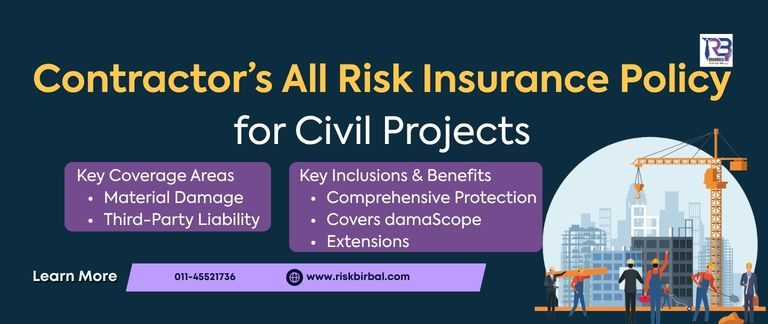
Let’s be honest—building a real estate project is stressful enough without worrying about a fire burning down your under-construction floors or a storm washing away your materials Contractors All Risk Insurance for Civil Projects protect your work. I’ve seen too many developers learn this the hard way, you actually need is Contractor’s All Risk Insurance Policy. That’s exactly why Civil Project Insurance for Real Estate Developers exists. And if you’re serious about protecting your money and reputation, you need to understand Civil Project Insurance inside out. Not tomorrow. Today.
Look, accidents don’t send a warning email. One minute your site is fine, the next minute there’s a crack in the neighboring building, or a worker drops a tool that damages a freshly poured slab. Without the right cover, you’re paying for all of it yourself. And trust me, that gets expensive real fast.
So What Is This Insurance Really About?
Think of Contractor’s All Risk Insurance Policy as your project’s bodyguard. It stays on site 24/7, ready to step in when something goes wrong. For a real estate developer, that means you don’t have to drain your bank account every time there’s an accident, a theft, or a natural disaster.
The best part? You don’t need to be an insurance expert to get it. You just need to know what risks you’re facing. And honestly, the list is long: stolen copper wiring, a crane toppling over, heavy rain flooding your basement excavation, even a random fire from a short circuit. All of these can shut down your project for weeks.
What Risks Does Civil Project Insurance Actually Cover?
Let me break it down in plain language, not insurance jargon.
Damage to Your Work-in-Progress
Walls collapse. Scaffolding falls. Pipes burst. If your partly-built structure gets damaged, the policy pays to fix or rebuild it.
Theft of Materials
I personally know a developer who lost over ₹8 lakh worth of cement and steel in one night. No insurance? He paid every rupee himself.
Natural Disasters
Earthquake, flood, cyclone, landslide—nature doesn’t care about your timeline. Civil Project Insurance covers repair costs so you can restart quickly.
Third-Party Trouble
A pedestrian slips near your site and breaks a leg. Or your piling work cracks a neighboring house. Suddenly you have a lawsuit. Liability cover handles the legal fees and compensation.
Delay Costs (Sometimes)
Some policies also cover financial losses if your handover gets delayed because of an insured event. That means you might avoid paying penalties to buyers or banks.
Contractor’s All Risk Insurance – The Real Hero
If there’s one policy every developer should know, it’s Contractor’s All Risk Insurance. This is the workhorse of the construction world. It covers both material damage and third-party liability in one package. Whether you’re building a row of shops or a 20-floor apartment tower, this policy has your back.
And when you start looking into Contractor’s All Risk Insurance, you’ll bump into other useful terms. These are related keywords that help you understand the full picture:
- Construction All Risk Policy– Same thing, different name.
- Contract Works Insurance– Focuses on the actual building works.
- Builders Risk Insurance– Popular term in global markets.
- Plant and Machinery Insurance– For your cranes, mixers, and excavators.
- Advance Loss of Profits (ALOP)– Covers income lost due to delays.
- Third-Party Liability Insurance– Handles claims from outsiders.
- Delay in Start-Up (DSU) Insurance– For commercial projects that need to open on time.
Oh, and one more: Erection All Risk (EAR) Insurance. You’ll rarely need this unless your project involves installing heavy machinery or electrical equipment—like elevators, generators, or factory setups. But it’s good to know it exists.
Why You’d Be Crazy to Skip This Insurance
I get it. Insurance feels like an extra cost. Another bill. But let me tell you a quick story.
A developer in Gurgaon decided to save ₹3 lakhs by not renewing his Civil Project Insurance. Two months later, a short circuit caused a fire on the 7th floor. Damage was over ₹60 lakhs. He had to sell his personal car and borrow from friends to complete the project. His reputation took a hit too—buyers lost trust.
Another developer I know paid for insurance. Same kind of fire happened. His insurer settled the claim in 22 days. He was back to work in less than a month. No loans. No stress.
So really, the question isn’t “can I afford insurance?” The real question is “can I afford not to have it?”
Benefits That Actually Matter to You
Let’s keep this practical.
- Protects your cash flow– Insurance pays the big bills so your own money stays safe for salaries, materials, and EMIs.
- Helps you win contracts– Most government and corporate tenders demand proof of Civil Project Insurance. Without it, you’re out.
- Covers legal headaches– Lawsuits are expensive. Even if you win, the lawyer fees hurt. Insurance covers that.
- Keeps banks happy– Try getting a construction loan without Contractor’s All Risk Insurance. Most lenders won’t even talk to you.
- Peace of mind– This is the big one. When you know you’re covered, you sleep better. And you focus better on actually building.
How to Pick the Right Policy Without Losing Your Mind
Follow these simple steps. Don’t overcomplicate it.
Step 1: Know your project value
Add up material cost, labor, equipment, everything. Your sum insured should match that number.
Step 2: Ask about add-ons
Basic policies might not cover earthquakes or floods. If your site is in a risky zone, pay a little extra for those extensions.
Step 3: Check the deductible
That’s the amount you pay before insurance kicks in. Lower deductible = higher premium. Pick what fits your pocket.
Step 4: Read what’s NOT covered
Wear and tear, faulty design, willful damage, war—these are usually excluded. Know them so you’re not surprised later.
Step 5: Talk to an advisor
Don’t just buy the cheapest policy online. A good advisor (like the team at RiskBirbal—you can check Contractor All Risk Insurance Policy for an idea) can compare multiple insurers and save you both money and trouble.
Conclusion
Look, construction is risky business. You already know that. Civil Project Insurance for Real Estate Developers isn’t some fancy extra—it’s basic protection. Contractors All Risk Insurance for Civil Projects protect your work as your best friend here. It covers damage, theft, liability, and sometimes even delays. Don’t wait for a disaster to happen. Get insured before you pour the first bucket of concrete. Your future self will thank you.
FAQs – Quick Answers to Common Questions
1. Is Civil Project Insurance the same as Contractor’s All Risk Insurance?
Not exactly. Civil Project Insurance is a broad category. Contractor’s All Risk Insurance is the most common and comprehensive type within that category. For most developers, that’s what you need.
2. Does this insurance cover my workers if they get hurt on site?
No. Worker injuries need a separate policy like Workmen’s Compensation Insurance or ESI. Don’t mix them up.
3. How long does a typical policy last?
Usually for the duration of your project—often 12 to 24 months. If your project gets delayed, you can extend it, but you’ll likely pay an extra premium.
4. Can I use the same policy for my next project?
Generally no. Each site and each project has different risks. You need a fresh policy for every new development.
5. Is Civil Project Insurance legally required in India?
Not for every private project. But many government contracts, bank loans, and even some municipal approvals make it mandatory. Even when it’s not required, skipping it is a bad idea.
6. What happens if I underinsure my project?
Big mistake. If you insure for less than the actual value, the insurer will only pay a proportional amount when you file a claim. That’s called the “average clause.” Always insure for the full replacement cost.