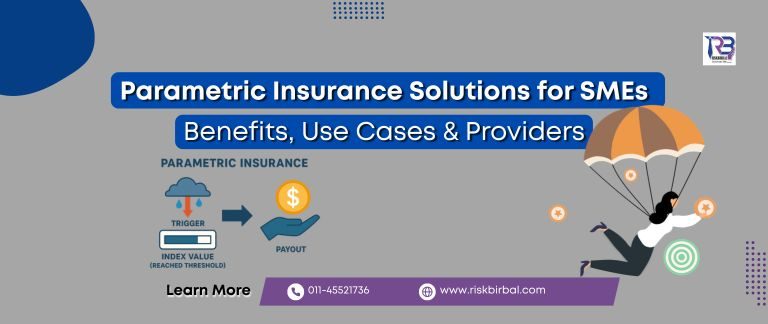
Small and medium enterprises (SMEs) often face unexpected losses from bad weather or natural disasters. Parametric Insurance Solutions for SMEs are changing how businesses handle these risks. One of the biggest Parametric Insurance Benefits is fast payouts without long claim investigations. In this blog, we will explain what parametric insurance is, how it works, and why it matters for your business. You will also learn about weather-based insurance, SME risk management solutions, and the best Parametric Insurance providers for your needs.
What Is Parametric Insurance for SMEs?
Parametric insurance is a type of policy that pays a fixed amount when a specific event happens. Unlike traditional insurance, it does not look at your actual damage. Instead, it uses a “trigger” like heavy rain, an earthquake, or high wind speed. When that trigger is met, you get paid automatically.
For example, if a storm drops 50 mm of rain in one day, your parametric policy pays $5,000. You do not need to prove how much you lost. This makes parametric insurance for businesses very simple and fast.
Parametric Insurance Examples include:
- A bakery getting paid for every day temperatures go above 40°C.
- A farm receiving money if rainfall is below a certain level.
- A hotel getting funds after an earthquake of magnitude 6.0 or higher.
These examples show how flexible and useful parametric insurance can be for SMEs.
Parametric Insurance Benefits
Why are more SMEs switching to parametric solutions? Here are the main Parametric Insurance Benefits:
- Speed of Payouts
Traditional claims can take weeks or months. With parametric insurance, payouts happen within days – sometimes even 24 to 48 hours. The trigger is measured by an independent data source (like a weather station). Once the data confirms the event, money is released automatically.
- Full Transparency
You know exactly when you will get paid. The trigger levels are written clearly in your policy. There are no hidden terms or arguments about damage value. This honesty builds trust and reduces stress.
- Cost-Effective
Because there is no need for loss adjusters or lengthy investigations, administrative costs are lower. Many SME risk management solutions become affordable with parametric insurance. You pay for the coverage you need, without extra fees.
- Flexible Coverage
You can design parametric insurance to protect your most critical risks. For example, a car wash may insure against low rainfall. A food truck may insure against extreme heat. You choose the trigger that matters to your business.
Use Cases of Parametric Insurance for SMEs
Let us look at real situations where parametric insurance helps small businesses.
Weather-Based Insurance
Many SMEs depend on good weather. A golf course needs dry days. A tour operator needs clear skies. With weather-based insurance, you set a trigger (e.g., three consecutive rainy days). If that happens, you receive a payout to cover lost income.
Natural Disasters
Earthquakes, floods, and cyclones can shut down your business for weeks. Parametric insurance for natural disasters uses government or scientific data. If an earthquake of a certain magnitude hits your area, you get funds within days. You can use that money for repairs, employee wages, or renting temporary space.
Business Interruption Scenarios
A power outage due to a storm could stop your production. A parametric policy can be triggered by the duration of the power cut. For example, if the power goes out for more than six hours, you receive $2,000 per day until it returns. This helps you pay fixed costs like rent and salaries.
Travel and Event SMEs
Small travel agencies or wedding planners can insure against heavy snow or fog that blocks travel routes. Payouts help you refund customers or reschedule events without losing all your profit.
How Parametric Insurance Works
Here is a simple step-by-step explanation:
Step 1 – Choose a Trigger
You decide what event will trigger a payout. Common triggers include rainfall (mm), wind speed (km/h), temperature (°C), earthquake magnitude, or flight delays.
Step 2 – Select a Payout Amount
You decide how much money you want to receive when the trigger is met. The payout is pre-set and does not depend on your actual loss.
Step 3 – Agree on a Data Source
You and the insurer agree on an independent, trustworthy data source. This could be a government weather bureau, a seismic monitoring agency, or a satellite service.
Step 4 – Buy the Policy
You pay a premium. The premium is usually a small percentage of the total payout.
Step 5 – Event Occurs
If the trigger condition happens (e.g., rainfall exceeds 100 mm in 24 hours), the data source confirms it.
Step 6 – Automatic Payout
The insurer pays the agreed amount directly to your bank account. No claim forms, no inspections, no delays.
Providers Offering Parametric Insurance
Several companies now offer parametric insurance products for SMEs. Here is a list of known providers:
- RiskBirbal Insurance Brokers – Specializes in affordable parametric solutions for Indian SMEs.
- Swiss Re – Offers parametric covers for weather and natural disasters globally.
- AXA Climate – Focuses on weather-based insurance for agriculture and small businesses.
- Munich Re – Provides parametric products for travel, energy, and retail SMEs.
- Arbol – A platform for custom parametric contracts using weather data.
- Blue Marble – Offers parametric microinsurance for low-income entrepreneurs.
Among these, RiskBirbal Insurance Brokers stands out for its deep focus on small and medium enterprises. We will explain why next.
Why RiskBirbal Insurance Brokers Are the Best
When looking for the best Parametric Insurance providers, RiskBirbal Insurance Brokers deserves special attention. Here is what makes them excellent for SMEs:
SME-Focused Approach
RiskBirbal understands that SMEs have small budgets and unique risks. They do not offer one-size-fits-all policies. Instead, they sit with you to understand your business. Do you run a roadside food stall affected by heat? A small warehouse prone to flooding? They design a parametric policy just for you.
Local Data and Triggers
Many global providers use international data that may not reflect your local reality. RiskBirbal partners with local weather stations and disaster monitoring agencies. This ensures triggers are accurate and fair. You are not waiting for a faraway satellite to decide your payout.
Fast and Simple Claims
RiskBirbal promises payouts within 48 hours of trigger confirmation. Their process is fully digital. You can buy, monitor, and receive payments through a simple dashboard. No paperwork. No hidden fees.
Affordable Premiums
Because parametric insurance removes many administrative costs, RiskBirbal passes those savings to you. Premiums can be as low as 1% to 5% of the payout amount. For example, a 10,000 payout might cost 300 per year.
Educational Support
RiskBirbal offers free webinars and guides on SME risk management solutions. They help you understand which risks are worth insuring. They do not push unnecessary products. This honest advice builds long-term trust.
If you want to compare multiple options, check out our detailed guide on the best Parametric Insurance providers for different industries. That blog covers pricing, customer reviews, and regional availability.
Conclusion
Parametric insurance is a fast, transparent, and affordable way for SMEs to manage weather and disaster risks. It pays automatically when a specific trigger is met. You get money within days, not months. This helps you recover quickly and keep your business running.
From weather-based insurance to earthquake covers, parametric insurance examples are growing every year. Providers like RiskBirbal Insurance Brokers make these solutions accessible to small businesses. They focus on local data, low premiums, and easy processes.
If you run an SME, do not wait for a disaster to surprise you. Explore parametric insurance today. It could be the smartest risk management decision you make.
FAQs
- Is parametric insurance cheaper than traditional insurance?
Generally, yes. Because there are no loss adjusters or damage inspections, administrative costs are lower. Premiums are often 1–5% of the payout amount. - How do I know the data source is reliable?
Reputable providers use independent, public data sources like government weather bureaus or seismic networks. These are agreed upon before you buy the policy. - Can I use parametric insurance as my only coverage?
It depends. For some SMEs, parametric insurance is enough for small to medium risks. For large, complex risks, you might combine it with traditional insurance. Always speak to a broker like RiskBirbal to assess your needs. - What if the trigger happens but I have no actual loss?
You still receive the payout. Parametric insurance does not require you to prove a loss. That is part of its simplicity. You can use the money for any purpose – even if your damage was minimal. - How fast is a parametric payout?
Most parametric policies pay within 48 to 72 hours after the trigger is confirmed. Some advanced policies pay in as little as 24 hours. - Does parametric insurance cover theft or fire?
No. Parametric insurance covers events that can be measured by an objective trigger – like rain, wind, temperature, or earthquake magnitude. For theft or fire, you would need traditional property insurance.